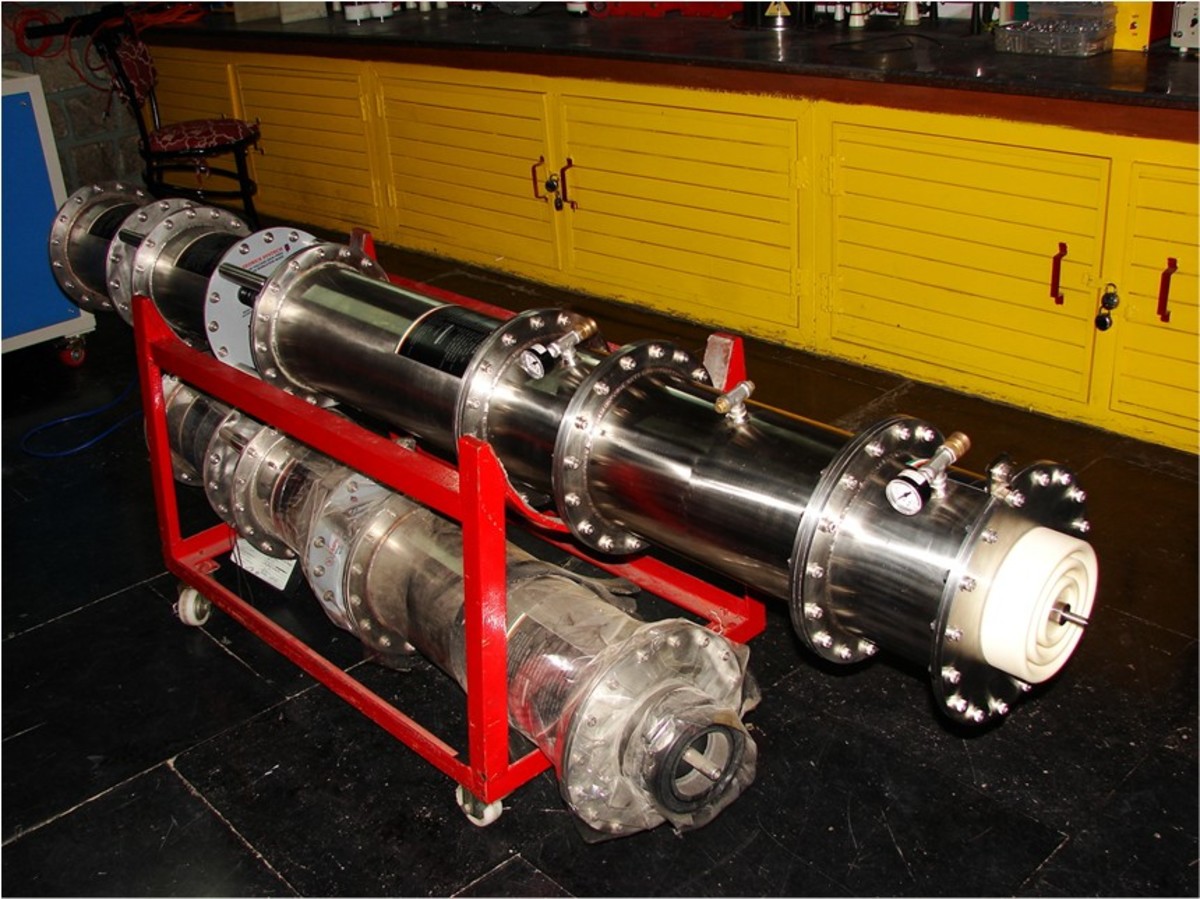
Mikel's third law of motion:

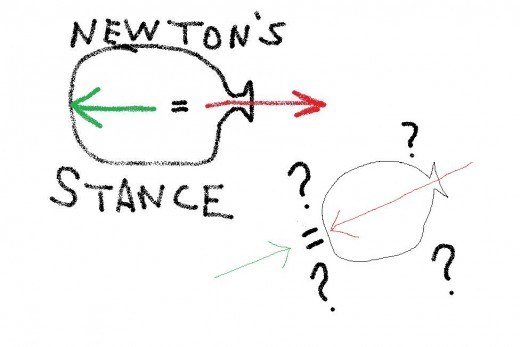
75Newton's Third Law of Motion:
For every action there is an opposite and equal re-action.
^^^^^^^^^^^^^^^^^^^^^^^^^^^^^^^^^^^^^^^^^^^^^^^^^^^^^^^^^^^^^^^^^^^^^^^^^
" No amount of experimentation can ever prove me right; a single experiment can prove me wrong." Albert Einstein
^^^^^^^^^^^^^^^^^^^^^^^^^^^^^^^^^^^^^^^^^^^^^^^^^^^^^^^^^^^^^^^^^^^^^^^^^
Newton's third law is incorrect
It is not possible for there to be an "equal and opposite" re-action for every action. What there are, are "consequences" for every action, and or non-action. Consequences that may or may not be equal and opposite.
An example of this law is what happens if we step off of a small boat onto the bank of a lake: as we move in the direction of the shore, the boat tends to move in the opposite direction. If the boat is very small when we push against it, it will shoot away from us. A demonstration that the force returned was not equal, is the consequence of us falling into the water. This disproves Newton's theory, so long as the amount of force the person is exerting against the very small boat, is an amount great enough to propel them to the shore (and counter the effects of gravity) if an equal amount of force is returned. Again since the reactionary force is less than the initial force, the person falls in the lake.
In the time it takes for the forces to interact there is a split second where the forces are equal and opposite, but after that split second the forces are UN-equal and may or may not be opposite. It is in that instant that motion is achieved. If one force is not greater than the other motion will not be attained. The forces are NOT equal and opposite for anything more than the split second it takes for the greater force to overpower the lesser force, and attain motion.
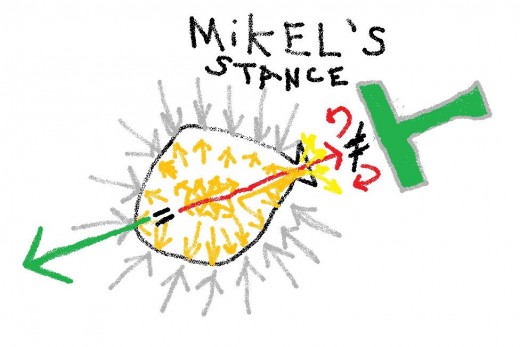
Part of Newton's flaw is in the assumption that every object has the capacity to return an infinite amount of force.
Small objects such as pebbles floating in space do not have an infinite amount of force to draw on. A man floating in space can exert a force on a floating pebble and send the pebble flying away without much or any reactionary force acting on the man. The fact that the pebble goes flying away and the man does not, is proof that Newton's third law is flawed.
^^^^^^^^^^^^^^^^^^^^^^^^^^^^^^^^^^^^^^^^^^^^^^^^^^^^^^^^^^^^^^^^^^^^^^^^
Mikel's third law of motion:
For every action (or non-action) there will be some kind of consequence. A consequence that may or may not be equal and opposite. Motion is possible because the involved forces are not equal and opposite. When the involved forces are equal and opposite motion cannot be attained.
^^^^^^^^^^^^^^^^^^^^^^^^^^^^^^^^^^^^^^^^^^^^^^^^^^^^^^^^^^^^^^^^^^^^^^^^
Quoted from comments:
'Q' said:
"A gross misunderstanding of Newtons third law on Mikel's part is the problem here.
F=ma
F is the force
m is the mass
a is the acceleration
If the mass fluctuates, as in the difference in mass between the man and the pebble, the acceleration must also fluctuate proportionally to the mass.
The boat example is even more flawed as Mikel fails to take into consideration friction."
Mikel says:
F=ma is the second law not the third.
The third laws equation is F= -F every time. Which of course is incorrect and proven false every time anything achieves motion. If F=MA of a football lineman and f=ma of a toddler the toddler's force equation will be less than that of the lineman, therefore F does not equal -F (with the situation being the lineman and toddler are pushing against each other). The smaller mass and acceleration of the toddler will result in a smaller -F than that of the lineman, therefore the forces will not be equal. Newton states they must always be equal, Newton and you are incorrect.
The mathematical expression Newton ascribes as the Third Law can only ever equal 0 and be correct. The only number in existence that can be both Equal and Opposite is '0'.
Zero is the only possible correct answer to the equation F=-F.

*The Emperor's new suit...
I think being afraid of being the only smart person in the room that didn't see how the third law was true, when everyone else evidently understood it, kept many smart people from saying anything. In my opinion what Newton describes in his third law is Stagnation.
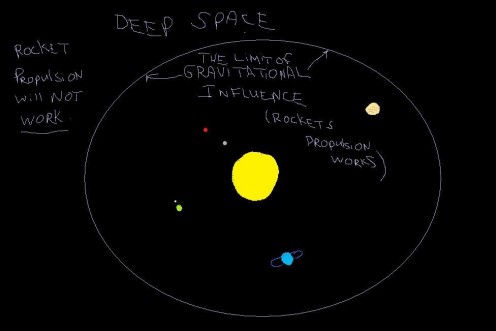
I further believe that as humanity branches out into deep space we will discover our propulsion systems won't function as we now believe they will. I think the failure of rocket propulsion in deep space will permanently prove my stance on the laws of motion.
The effects of the huge gravitational forces in our solar system are what allow our propulsion systems to work in space, and that is why it seems like Newton was correct. But about this he wasn't correct and neither are some of the theories about black holes... Holes in Space?
vote upvote downshareprintflag
- Useful (2)
- Funny (2)
- Awesome (2)
- Beautiful (1)
- Interesting (1)
CommentsLoading...
Not sure I follow. One one side of your example, you have a large mass times a tiny acceleration and on the other side, you have a small mass times a large negative (relative to the other) acceration. All Newton is saying is MAsubP = MAsubB*(-1). So, to disapprove Newton's Third Law, you have show the acceleration of the boat away from the person is not MAsubB/MsubB, assuming the boat is on a frictionless surface.
Are you suggesting, Mikel, there are two types of masses and two types of accelerations in the universe and more specifically, on Earth? That the mass of the football player has different charateristics than the mass of the toddler other than in quantity of mass and that the change in speed over time of a football player is somehow a different thing than that of a toddler? I have never heard of that before.
What would be your imperical evidence?
Oh, all the minus sign means is the acceration is happening in the opposite direction; direction is a component of acceration. Also, Newton is talking about two objects acting on each other, not independently; the full law is "The mutual forces of action and reaction between two bodies are equal, opposite and collinear". Your example of the football player and toddler describe two independent objects. Now, let the toddler run into the leg of the football player and bounce off; it is that situation in which the 3rd Law applies.
If you are standing on a floor, you are applying the F of your weight (MA) 'down' on the floor where M is your mass and A is the acceration due to gravity with down being positive. In order for you not to fall through the floor, it has to be pushing back with an equal and opposite force. Since the floor is attached to the earth in some fashion, I am making that assumption in this example, then M is the mass of the earth and the acceleration, which is due to the attraction of the earth to your body, is 'up' toward you, which is defined as negative. The "opposite" in "equal and opposite" simply means the forces are acting in opposing directions which is possible since all forces act in some direction given that if acceleration is zero, then force must be zero.
Not sure what you mean. By definition F=ma; if 'a'=0, then F must be zero regardless of 'm'; that exists, in a practical way, only in space, however, since you can always find things bouncing off of each other.
Of course it is, but the third Law is the one you are talking about. The second Law simply defines what Force is. Since F=-F and F=ma, then by substitution and reversing terms so that I can put the minus sign in front of the 'a', am = -am which leads to what I said earlier, with the appropriate subscript identifiers as to which F you are talking about on each side of the equation. Remember also, that the acceleration we are talking about isn't the acceleration of the objects prior to contact but the acceleration DUE to the contact.
For example, the acceleration due to gravity (g) is about 32 feet per second per second. So, a person standing on the ground is decelerating at 'g' upon contact with the ground and therefore has a force of
-am, with the minus sign indicating deceleration. In order for the person not to push the earth away, the earth must be, because of F=-F, accerating up toward the person, due to gravitational attraction, at such a rate that when multiplied by the mass of the earth is equal to the weight of the person standing on it. If what you say is true, a person could not stand upon earth.
You still have your math wrong, I think. If F1 = - F2, then switching sides, F1 + F2 = 0; you have to have the subscripts because the two Fs are made of different Ms and As. Substituting, you have M2A1 + M2(-A2) = 0. I think that is a subtlety I missed showing before. Remember the accerations are in opposite directions so the As have opposite signs.
Generically, F=-F and F=MA, but specifically F1=-F2 and F1 = M1A1 and F2 = M2(-A2). Substituting back, you have M1A1 = -(M2(-A2)) or M1A1 = M2A2, so substituting againg you get F1 = F2. Isn't M1A1 opposite of -M2A2?
BTW, what would be the physical reality if the Third Law weren't true?
BTW, again, it took a couple three listens through some lectures on quantum mechanics before I started getting some understanding of how the partical-wave duality thing works, wierd; it ultimately boils down to string theory somehow.
But, 1 does equal -(-1) assuming F=-1, which it can if 'A' is negative. When will 'A' be negative? As I have said, when the second object is moving in the opposite direction relative to the first object. So, the third Law holds. Maybe it will be clearer if you consider the formula to be F1 = -1 x F2, where F2 takes on the sign of the associated A2.
No, because the -1 is a separate element from F it is associated with, there are three elements to the equation, not two; the equal part, F=F, and the opposite part, -1 x F, where F can take on any value positive or negative.
Sure, let's assume the following:
- there are two masses M1 and M2, both 10 kg each.
- each are travelling in opposite directions, one with a velocity, V1, of 1 cm/sec and the other with a velocity, V2, of -1 cm/sec; negative because V2 is opposite and relative to V1.
- they collide perfectly head-on
- the collision is perfectly elastic
- the initial velocity U1 and U2, respectively, are the same as the velocity just prior to impact, V1 and V2, respectively
the time from the beginning of the experiment to the end of the experiment is 2 seconds, and the time of the begining of the experiment to the point of impact is 1 second.
When they hit, they both rapidly deccelerate to zero then accelerate in the opposite direction at the same velocity, but now with an opposite signs. Now for the math to derive the acceleration.
First, because in a perfectly elastic collisiong, momentum is conserved, therefore the velocity approaching the point of impact is equal to the velocity leaving the point of impact, but with the sign changed because the direction of movement was reversed. Knowing this and that acceleration A = (U - V)/t, where U is the initial velocity, V is the final velocity, and t is time, we get for our whole experiment A1 = (U1 - V1)/t = (velocity approaching point of impact - veolicty leaving point of impact)/time = 1 - (-1))/2 = 1cm/sec/sec.
Similarly, A2 = (U2 - V2)/t = ((-1) - 1)/2 = -1 cm/sec/sec.
F1 = -1*F2 which is identical to M1A1 = -1*M2A2 which is identical to 10 * 1 = -1*10*(-1)which is identical to 10 = 10. Voila!
The "extra" -1 comes in because one of the two "A"s is negative with respect to the other; they cannot both be positive because they travel in opposite directions.
Just my simple minded understanding.
It seems to me that absorption of that opposite force isn’t being considered.
The same bullet being fired from a bolt action or a semi-automatic rifle will travel at different speeds and distance. A firecracker going off; imbedded in a marshmallow or a rock produces a different outcome. The resistance, both behind and in front (on all sides) of the force being applied affects the outcome. Or something like that?
I have found that when I am wrong. I am not taking something into consideration. Maybe I’m doing it again?


My Esoteric Level 6 Commenter 6 months ago
The problem with your very small boat example is you forget that Force = Mass times Acceration. So, the question is, did the mass of the person times acceration of the person going forward as he or she was falling forward equal the mass of the boat times its acceleration going in the opposite direction?